
2026/7/15 – Updated Comparison with uTracerNXT
As I mentioned in one of my earlier articles, the original goal of the etracer project was to create an enhanced version of the uTracer. However, the project eventually evolved into a completely new design that shares very little with the uTracer except the concept of using a charged capacitor to provide the high voltages required during measurement pulses.
The first comparison in this article was published in 2017 and compared the etracer with the original uTracer3, which was the latest model available at the time. In 2026, the uTracer series was updated with the introduction of the uTracerNXT, addressing several limitations of the original design, including a higher maximum test voltage. Although the etracer hardware architecture was introduced nearly ten years ago, it still offers several significant advantages over the latest uTracerNXT.
To reflect the evolution of both products, this article now includes comparisons with both the original uTracer3 and the newer uTracerNXT.
The original comparison with the uTracer3 is reproduced below for reference.
| etracer | utracer3 | |
| High voltage supply range | 0~750V | 0~400V |
| Negative supply range | 0~-180V | 0~-40V |
| Heater supply | 1.5V~27V regulated DC supply with a current capacity of at least 3A. One side of the heater supply is always connected to the system ground by a 0.1ohms current sensing resistor. | Heater voltage is emulated by chopping the 19V DC input. Or an external DC supply is required. |
| High voltage supply topology | Output voltage is 0~750Vdc referred to the system ground. | Output voltage is 19V above the system ground. When making a measurement the heater needs to be disconnected from the system. |
| Voltage charging time | Sophisticated DSP algorithms ensuring accuracy in the low-voltage range and fast charging time in the high voltage region | Fixed charging period. Charging time is significantly longer in the high voltage range (>200V) |
| ADC resolution and sampling rate | 14 bits/ 900k samples/sec |
10 bits |
The following table compares the etracer with the current uTracerNXT.
| etracer | utracerNXT | |
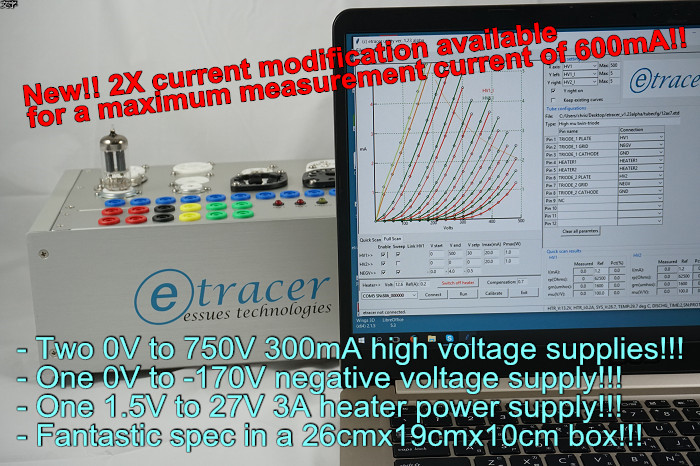
| High voltage supply range | 0~750V/300mA (Sufficient voltage for fully characterizing tubes such as the 300B, 50 and KT88) | 0~500V/350mA (Maximum voltage may limit characterization of high-voltage power tubes) |
| Negative supply range | 0~-180V (Provides sufficient grid-bias range for fully characterizing tubes such as the 300B and type 50). | 0~-120V (Still insufficient for fully characterizing tubes such as the 300B and 50). |
| Heater supply | 1.5V~27V regulated DC supply with a current capacity of at least 3A. One side of the heater supply is always connected to the system ground by a 0.1ohms current sensing resistor. | Heater voltage is emulated by chopping the 19V DC input. Or an external heater supply is required. |
| ADC resolution and sampling rate | 14 bits/ 900k samples/sec | 10 bits |
In addition to the technical differences, the etracer is offered as a fully assembled PCB using modern SMD (surface-mounted device) components and SMT (surface-mount technology), whereas the uTracer is provided as an unassembled kit. The etracer also features an optional companion chassis, the Model-01, designed to save users valuable time and reduce potential frustration.
Last but not least, the etracer's greatest strength is not just its hardware, but the software ecosystem that has evolved around it over the past decade. The Python-based PC software continues to receive active feature updates and provides capabilities that go far beyond basic tube characterization. Features such as PDF and CSV export, label printing, load-line analysis, gas testing, automatic tube wiring with the Sbox12, and a flexible software architecture ensure that the etracer continues to evolve long after the hardware was introduced.
Although the etracer hardware architecture is now nearly ten years old, its mature software platform and continued development allow it to remain a compelling choice for vacuum tube enthusiasts, collectors, dealers, and repair professionals alike.
